
Peace Circle®
Turning small urban green spaces
into shared places for community,
learning and nature.

Peace Circle® is a civic public space model first implemented in 2024 in Liperi, Finland. It offers cities a scalable and cost-efficient way to transform municipal green areas into shared spaces for community, ecological care and everyday civic interaction.
Co-designed with residents and realised in partnership with the municipality, the circular structure embeds participation directly into the built environment — making biodiversity, community and shared responsibility part of everyday urban life.
-
20+ years of international environmental and peace education
-
150+ countries involved in the ENO network
-
4 countries with Peace Circle® implementations
-
0€ licensing fees for cities and municipalities

The first Peace Circle® was established in a newly developed residential area in Liperi, where community identity was still emerging. Located along a pedestrian and cycling route near the town centre, it is embedded in daily movement and accessible without barriers.
The project transformed a municipal green area into a circular gathering space structured around equality. Its geometry removes hierarchy — no stage, no front, no back — placing all participants in the same spatial position.
At the centre of the circle stands a peace tree. It may symbolise the community or the city, but also each person who enters the park and their place within the shared circle. Three value lines extend from the central tree, making the Peace Circle’s shared values visible in the physical structure of the park.
The trees forming the outer ring may be named by the community or city after selected peace or environmental changemakers at international, national and local levels. In this way, the park connects shared values with people who have translated them into visible action, while linking the local community to a wider story of peace and environmental responsibility.
Meadow areas enhance biodiversity, while the compact layout supports both physical and social accessibility.
Co-Designed With the Community

From the outset, Peace Circle® was developed through an open participatory process. Residents, local associations, schools and municipal representatives co-defined the design, purpose and long-term stewardship of the space.
Between 20 and 50 volunteers took part in community work days, contributing directly to its physical realisation. The initial implementation was financed through local crowdfunding (€5,000), establishing civic ownership from the beginning.
Rather than imposing meaning through design, the space emerged through collective decision-making. The shared values expressed through the value lines and the people honoured by the surrounding trees are chosen through community dialogue.
Civic Practice in Everyday Life
Peace Circle® functions as an actively used civic space. In spring 2025, more than 200 local schoolchildren engaged in dialogue within the circle, linking environmental stewardship with democratic responsibility across generations.
The space is regularly used for school dialogues, community meetings and seasonal gatherings. Within walking and cycling distance of the neighbourhood centre, it integrates democratic interaction into everyday routines.
The municipality has formally integrated the space into its maintenance and community structures through a cooperation agreement, ensuring landscape care, watering and seasonal protection. The model is also used in local education, connecting civic practice with learning environments.
Located in Eastern Finland near the EU’s external border, the project operates within a broader geopolitical context where strengthening local trust and participation carries particular relevance.

Sustainable by Design
Peace Circle® operates through a cooperative governance structure balancing civic initiative with municipal responsibility. The initiating association leads community engagement and programming, while the municipality ensures long-term maintenance, including watering and landscape care.
Local companies contribute through modest annual commitments, reinforcing shared responsibility without commercialising the space.
This distributed stewardship model creates a durable framework for democratic practice: citizens shape the space, public authorities secure its continuity, and local actors sustain its everyday care. By distributing responsibility across civic, municipal and local actors, the structure reduces dependency on large-scale funding.
Because the model relies on cooperation rather than infrastructure scale, it can be adapted to rural municipalities and dense urban contexts alike.
A Transferable Structure
The core spatial structure — a central gathering tree, radial value lines and surrounding civic ring — provides a clear template adaptable to different cultural and environmental contexts.
The model can be implemented in neighbourhood parks, schoolyards or other small public green spaces, making it suitable for both dense megacities and smaller municipalities.
The model requires modest financial investment and relies on collective agency rather than infrastructure scale. Rather than exporting a fixed design, the approach offers a transferable process through which communities shape their own civic space while embedding sustainability, inclusion and shared responsibility into the built environment.
How a Peace Circle® Can Be Established
A typical implementation process includes:
• Site selection in collaboration with the municipality
• Participatory co-design with residents and local actors
• Phased landscape realisation (central tree, value lines and surrounding circle)
• Integration into school and community activities
• Long-term maintenance agreement between civic initiative and municipality
Because the model relies on cooperation rather than large infrastructure investment, implementation remains financially accessible and administratively realistic.
The Peace Circle® framework is made available to municipalities without licensing fees. Use of the Peace Circle® name and formal inclusion in the international network are based on cooperation agreements to ensure quality, shared principles and long-term integrity of the model.
Advisory support and facilitation can be agreed separately according to local needs and local context.
What Peace Circle® Offers to Cities
• A compact, cost-efficient urban design model
• A visible symbol of equality and shared space
• A biodiversity-enhancing green intervention
• A structure for citizen co-creation
• A framework connecting schools, communities and climate goals
• A replicable model adaptable to local culture
Long-standing experience and a growing international network
Peace Circle® builds on ENO Schoolnet, founded by Mika Vanhanen more than 20 years ago, and its international work in environmental and peace education. Schools from more than 150 countries have participated in ENO activities, leading to millions of trees being planted around the world.
In addition to Finland, Peace Circles have been established in Italy, Bosnia and Herzegovina, and Zambia. Each implementation is shaped by its local community, culture and environment while following a shared set of principles
Long-standing experience and a growing international network
Peace Circle® builds on ENO Schoolnet, founded by Mika Vanhanen more than 20 years ago, and its international work in environmental and peace education. Schools from more than 150 countries have participated in ENO activities, leading to millions of trees being planted around the world.
In addition to Finland, Peace Circles have been established in Italy, Bosnia and Herzegovina, and Zambia. Each implementation is shaped by its local community, culture and environment while following a shared set of principles
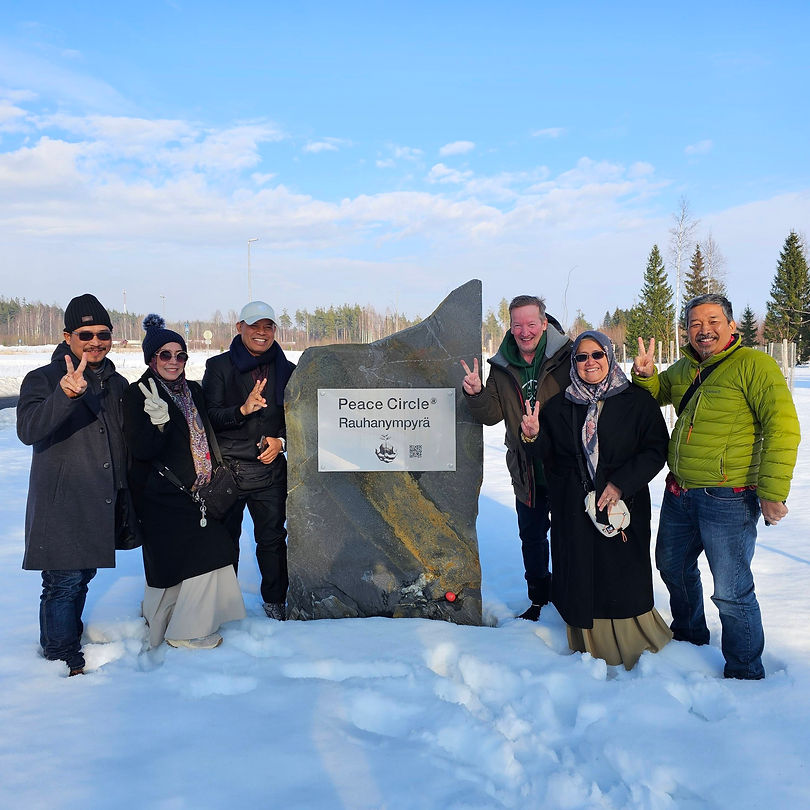
International visit exploring the Peace Circle in Liperi (March 2026)